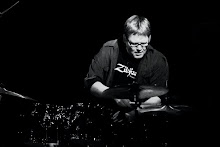
Here's a short couple of exercises from drumming great Simon Phillips.
Even though they are designed for 2 bass drums you can easily try the examples with the left foot on H.H.
I love Phillips' post-Cobham very muscular style of playing although it often makes me feel like my drumming is the equivalent of a 5 year old girl at a tea party!
Sunday, March 24, 2013

Sunday, March 17, 2013
Saturday, February 23, 2013
Heel/toe stuff.
Hey all,
Just a quick post about what I've been working on lately.
I've been checking out doing sort of a rocking motion with each foot. In the right foot it creates either a muffled pitch bend sound on my relatively open bass drum (heel up, keeping beater in the head) or an open sound (heel down, rebound off the bass drum head). In the left foot it creates either a closed sound (heel up) or a hi-hat splash (heel down). Here's just a quick example. Sorry for the darkness of the video.
One of the issues when using this technique is having the feet moving the opposite direction from each other. It's challenging! I'm also working at being able to throw this in in triplets etc.
Like any new idea (and different set of movements) it's a bit awkward and doesn't sound that great. Even when it's working better it might be a while before I can use these in a musical context, if ever.
I'm committed to letting this come out in an organic way and not forcing it on the music.
Try it if you feel like it.
Thanks.
Just a quick post about what I've been working on lately.
I've been checking out doing sort of a rocking motion with each foot. In the right foot it creates either a muffled pitch bend sound on my relatively open bass drum (heel up, keeping beater in the head) or an open sound (heel down, rebound off the bass drum head). In the left foot it creates either a closed sound (heel up) or a hi-hat splash (heel down). Here's just a quick example. Sorry for the darkness of the video.
One of the issues when using this technique is having the feet moving the opposite direction from each other. It's challenging! I'm also working at being able to throw this in in triplets etc.
Like any new idea (and different set of movements) it's a bit awkward and doesn't sound that great. Even when it's working better it might be a while before I can use these in a musical context, if ever.
I'm committed to letting this come out in an organic way and not forcing it on the music.
Try it if you feel like it.
Thanks.
Friday, February 1, 2013
Thursday, January 31, 2013
Modern Drummer Article
Hey everyone,
Just a short post to let you know my latest Modern Drummer article will be in the March 2013 issue.
Here's some demos of the subject matter, "The Blam"
Thanks!
Just a short post to let you know my latest Modern Drummer article will be in the March 2013 issue.
Here's some demos of the subject matter, "The Blam"
Thanks!
Monday, January 7, 2013
Happy New Year
Hello all,
Just a quick post to say Happy New Year!
I recently was at Humber studios recording with John MacLeod's Rex Hotel Orchestra and Al Kay managed to capture a little bit on video.
Yeah! Dig the trombone-cam!
The tune we recording was the closing theme to the Wayne and Shuster Show (Canadian comedy show from the '70s that the band's spiritual guide, Rick Wilkins, recorded, wrote, and arranged as well as sang with us on the session.)
Finally, sad news from the nation's captial as word spreads of the passing of Jacques Emond, the former programming manager of the Ottawa Jazz Festival.
Jacques was a great guy and as many Jazz festivals became corporate machines, he was always very personally involved and genuinely loved the music. He will be missed.
See you soon, I hope!
Just a quick post to say Happy New Year!
I recently was at Humber studios recording with John MacLeod's Rex Hotel Orchestra and Al Kay managed to capture a little bit on video.
Yeah! Dig the trombone-cam!
The tune we recording was the closing theme to the Wayne and Shuster Show (Canadian comedy show from the '70s that the band's spiritual guide, Rick Wilkins, recorded, wrote, and arranged as well as sang with us on the session.)
Finally, sad news from the nation's captial as word spreads of the passing of Jacques Emond, the former programming manager of the Ottawa Jazz Festival.
Jacques was a great guy and as many Jazz festivals became corporate machines, he was always very personally involved and genuinely loved the music. He will be missed.
See you soon, I hope!
Wednesday, December 19, 2012
The sounds we make......
Hey all, it's been a while.
Here's an article I've been working on lately.
In my function as an instructor and clinician, I sometimes run into issues with young players around listening. In these particular cases, it isn’t an issue of not listening to the rest of the band, it’s listening to themselves and the sounds they are making on the drumset. Often it feels like the drums are making the choices of what it sounds like, rather than the individual playing them. In this article, I’d like to go through the various parts of the standard drum set and discuss how we can consciously make better choices to get a good quality sound.
Snare Drum
On the snare, as well as all the drums the normal “default” place to play is the middle of the drum head. Simple, huh? Yet a lot of players left their hands fall to various places on the drum and get an inconsistent sound. We all need to get in the habit of playing in the centre of the drum. A good way to work on this is to play german grip (palms flat) and make a triangle that takes up a quarter of the drum. Listen to the sounds as you play there. You should hear less ring and overtones than when you play to the edge of the drum. Get used to this as a place to start playing the drum and your body and ears will know how to adjust when your hands drift.
Rimshots or not?
Another issue with the snare I hear is that we need to be consistent where and when we are playing rimshots. A good way to practice this is to play a simple beat and play beats 2 and 4 as rimshots for 4 bars, then as accented notes in the centre of the drum. This will get us used to being aware of when we are using rimshots. See exercise 1.
Bass Drum
2 of the standard ways to play bass drum are to play the foot into the drumhead and leave it there and to play off the head, removing the pedal beater right after the drum is struck. Both approaches have validity in various situations.
If you have difficulty playing “off’ the bass drum head, try imagining that the pedal wants to return to the at rest position (with the beater flexed away from the drumhead).
Cymbals- Cymbals are played mainly in 3 areas. The bell or crown (in the centre) to create a cowbell like sound, the edge (with a glancing blow with the shaft of the stick, or half way between these 2 areas. For all purpose riding/time keeping.
I often hear drummers riding the cymbals way down at the edge of the cymbal. This creates a lot of overtone build up and doesn’t give the band the definition in the time it needs. Remember, ALL cymbals are rides or crashes, depending on how you play them.
Hi-Hat- All the issues with the hi-hat are the same with one notable exception, splashing the hi-hat with the foot.
This is a sound that can be overused and quite obnoxious if played thoughtlessly. Also, when we are splashing, are we releasing the cymbals completely, or are we allowing them to “buzz” after the initial attack? Practice this both ways!
Working on habits.
If you do find yourself with a physical habit that’s hard to break, one way to get your body and ears aware of it is to practice playing ONLY the habit.
Play a lot of snare rimshots without thinking about it? Practice playing a beat or solo using ONLY rimshots on the snare, and the toms as well! (For a great example of how great rimshots on the toms can sound, check out Jack DeJohnette’s opening solo on “Salsa for Eddie G” from New Directions in Europe.).
Play to far to the edge of the cymbal while playing jazz time? Play Jazz time while crashing the cymbal only! Using methods like these will help you get used to playing specific sounds on purpose.
In conclusion if we really HEAR the sounds we’re making we can create beautiful music.
Here's an article I've been working on lately.
In my function as an instructor and clinician, I sometimes run into issues with young players around listening. In these particular cases, it isn’t an issue of not listening to the rest of the band, it’s listening to themselves and the sounds they are making on the drumset. Often it feels like the drums are making the choices of what it sounds like, rather than the individual playing them. In this article, I’d like to go through the various parts of the standard drum set and discuss how we can consciously make better choices to get a good quality sound.
Snare Drum
On the snare, as well as all the drums the normal “default” place to play is the middle of the drum head. Simple, huh? Yet a lot of players left their hands fall to various places on the drum and get an inconsistent sound. We all need to get in the habit of playing in the centre of the drum. A good way to work on this is to play german grip (palms flat) and make a triangle that takes up a quarter of the drum. Listen to the sounds as you play there. You should hear less ring and overtones than when you play to the edge of the drum. Get used to this as a place to start playing the drum and your body and ears will know how to adjust when your hands drift.
Rimshots or not?
Another issue with the snare I hear is that we need to be consistent where and when we are playing rimshots. A good way to practice this is to play a simple beat and play beats 2 and 4 as rimshots for 4 bars, then as accented notes in the centre of the drum. This will get us used to being aware of when we are using rimshots. See exercise 1.
Bass Drum
2 of the standard ways to play bass drum are to play the foot into the drumhead and leave it there and to play off the head, removing the pedal beater right after the drum is struck. Both approaches have validity in various situations.
If you have difficulty playing “off’ the bass drum head, try imagining that the pedal wants to return to the at rest position (with the beater flexed away from the drumhead).
Cymbals- Cymbals are played mainly in 3 areas. The bell or crown (in the centre) to create a cowbell like sound, the edge (with a glancing blow with the shaft of the stick, or half way between these 2 areas. For all purpose riding/time keeping.
I often hear drummers riding the cymbals way down at the edge of the cymbal. This creates a lot of overtone build up and doesn’t give the band the definition in the time it needs. Remember, ALL cymbals are rides or crashes, depending on how you play them.
Hi-Hat- All the issues with the hi-hat are the same with one notable exception, splashing the hi-hat with the foot.
This is a sound that can be overused and quite obnoxious if played thoughtlessly. Also, when we are splashing, are we releasing the cymbals completely, or are we allowing them to “buzz” after the initial attack? Practice this both ways!
Working on habits.
If you do find yourself with a physical habit that’s hard to break, one way to get your body and ears aware of it is to practice playing ONLY the habit.
Play a lot of snare rimshots without thinking about it? Practice playing a beat or solo using ONLY rimshots on the snare, and the toms as well! (For a great example of how great rimshots on the toms can sound, check out Jack DeJohnette’s opening solo on “Salsa for Eddie G” from New Directions in Europe.).
Play to far to the edge of the cymbal while playing jazz time? Play Jazz time while crashing the cymbal only! Using methods like these will help you get used to playing specific sounds on purpose.
In conclusion if we really HEAR the sounds we’re making we can create beautiful music.
Subscribe to:
Posts (Atom)