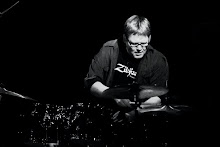
In my post the other day I stated that I thought the idea of getting "out of shape" on one's instrument was primarily a mental trick. I also mentioned we can avoid this trap if we get out of our own way and not focus on the time we've been away from our axe. But what do we do when we can't play our instrument? Here's some ideas how to not feel distant from music and our instrument when we can't physically play it.
1. Mentally Practice
I've mentioned this in previous posts but it bears repeating. Simply imagine playing the drums as completely as you can. How it sounds, how it feels, all of it! I found this helps immensely and I'm convinced this is how touring musicians stay loose while not playing their instruments except at the gig.
2. Listen to lots of music
Learn tunes, imagine yourself playing along (see above) etc.
3. Sing
You don't have to be an opera star to sing tunes, chord tones, or scales. You can also "vocalize" drum ideas to work on at the kit later.
In conclusion, don't despair if travel, illness, or irate neighbours keep you from the drums. There's still a lot you can work on. As Art Blakey said "You are the instrument!"
Wednesday, January 7, 2015

Tuesday, January 6, 2015
Mind over Matter
Hello,
Recently I came across a young drummer's statement online of how out of shape his playing felt after a recent vacation. I know this individual as a working professional who has obviously worked hard at developing knowledge and skills on the drums, and his playing never fails to impress me.
I too, have often thought my skills have diminished after some (voluntary or circumstance-imposed) time off. My approach to this has changed in recent years, however, and I have come to believe this is another losing game we musicians tend to play against ourselves.
I believe that if a musician has spent enough time learning his/her instrument, he/she reaches a level that cannot be washed away by a little time off. (Although there is debate about it, I feel the 10,000 hours rule applies here.) I also believe that most of the "loss of chops" we tend to feel is in our minds and our body knows what we have trained it to do as long as we get out of its way. The great Glenn Gould apparently felt like he should be able to play to his full potential any time of the day or night. I'm sure he did. Why? Because he believed it!
Notice I said earlier that we reach this level if we've spent enough time on the instrument.
When I don't play piano or harmonica for awhile I can feel my skills atrophy. That's because I haven't put in enough time on these instruments. There is no substitute for this.
So if you're an experienced musician who has been away from your instrument for one reason or another. Don't tell yourself you're out of shape! What should you tell yourself? We'll explore that in the next post. Stay tuned........
Thursday, October 23, 2014
Florian Alexandru-Zorn brush technique
As well as my double pedal adventures, I've been working on this brush technique from Florian Alexandru-Zorn. What basically happens that's new to me is that we accent on the sweep up the drum (when the brushes are moving away from us) as well as when the brushes are moving toward us. It's a little awkward for me, especially in the left hand, but it's slowly improving. Anyway, check it out and see what you think.
Wednesday, October 22, 2014
Couple of recent videos
Tuesday, October 21, 2014
Muting the Bass Drum with Double Pedal
Hey folks!
I recently acquired a double pedal for my bass drum after many years without one.As well as practicing single strokes between the feet (yes I know it's a serious cliche, but it's the most logical place to start ) I found that if I did the "normal" things with my left foot as if I was playing hi-hat I could mute the bass drum. In other words, if I keep the left foot pedal resting against the head I can mute and raise the pitch of the bass drum, which creates some interesting possibilities.......

Try this foot pattern with any bossa or samba beat. (Note: I've written the left side pedal on the hi-hat space.)
In the second example, which also works well with Brazilian style beats, the left foot is muting on beats 1 and 2, resulting in a quasi-surdo feel. Remember not to flam beat 1.

Example 3 is the same as example 1 except now we're swinging the 8th notes. I once heard Steve Gadd play this underneath a shuffle (during a shout section with a big band no less!)


Friday, May 9, 2014
Pete LaRoca brush pattern
Hey all, here's a right hand brush pattern I stole from Pete LaRoca. The lines represent brush sweeps from side to side (I prefer moving to the left first) and the dots are regular taps. You can play this with any left hand comping with cross stick. I found it a bit challenging at first coordination-wise but it's a nice groove that works at a lot of tempos. Plus it has us incorporating different motions into our right hand repertoire, which aids flexibility. Have fun!
Thursday, May 8, 2014
Two Brush Patterns
Just 2 brush patterns today. You'll have to figure them out between the description and diagrams only. I'm unable to film the examples right now, even in my lowly phone book form, because my house is being renovated and I'm up to me ears in (Barney) rubble!
Both patterns use the concept of the left hand moving back and forth in basically a straight line. In Philly In 3 , the left hand is doing this in a triplet rhythm. The pattern is basically Philly Joe Jones' Trill, but in 3/4. This creates an extra wrinkle because the left hand keeps switching which side of the drum it's on. In other words, if you start the triplet sweep moving towards you on beat 1, in the next bar on the downbeat the left hand will be moving away from you. This will take a little getting used to, but with a little practice you'll have a nice flow of triplets in the sweep.

Also I should mention that all the right hand does is taps out a standard 3/4 ride pattern.
In the second example, you're going to be doing the same motion with your left hand, but it's now not going to be in any particular rhythmic grouping. Think of the left hand in this case as "vibrato" rather than timekeeping. You can experiment with how fast or slow the left hand moves as well. The right hand will keep the time with the one big half note circle it makes.

I hope you enjoy working on these patterns and I promise I'll post again soon.
Subscribe to:
Posts (Atom)