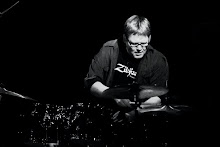
Yikes, this weather isn't endomorph friendly by any stretch of the imagination! Regardless, while sweating in the apartment I came up with this very simple yet (imho) effective 12/8 pattern on brushes. it uses the brush "buzzes " again and does them whenever there's a capital R in the sticking.
RlRlrR lRlRlr
Check it out....
Saturday, July 6, 2019

Thursday, July 4, 2019
The Dangers of Drum Corps
I can't remember if I've mentioned this before, but I grew up playing in marching bands. I played bass drum, snare drum, tri-toms, cymbals and glockenspiel in my time with the Lions Band. The Lions Band was not a drum corps ( as we still had reed instruments ) but in the early 80s, the band certainly had drum corps aspirations. I must admit, at first I got caught up in it, but after awhile, I started to see elements in it that were problematic. Let's look at a few, shall we?
1. Drumset is an instrument born of individual, not group thinking.
The trap set's early objective was to take a role that was performed by two drummers, that is, badd drum and snare drum, and have an INDIVIDUAL perform this function. Drum corps, with it's emphasis on uniformity, is the antithesis of this. I personally don't think it's always healthy to have stickings to a particular passage dictated to us. Stickings are a mode of expression, and the main reason I switched to glockenspiel was that, even within the confines of the marching band, i got a bit of my individuality back, as no one else was playing my instrument.
2. Drum Corps values technique over sound.
Modern American marching snare drums tend to sound ( and feel ) like tabletops. The harder (tighter) the drums surface, the more bounce. The snares are on super tight, creating a super dead, dry, sound that helps show off the uniformity of the players. To me, it's a very uninspiring sound, and all the Corps' drums tend to sound the same.
3. Only certain techniques are valued.
Ever notice how none of the lists of rudiments has any buzz rudiments ( other than the one buzz roll ) or any dead stroke rudiments. Why? Because most of those lists are decided by DRUM CORPS instructors, and buzzes and dead strokes sound crappy on the table top sounding drums when 20 people are playing them out in a field. But you know what? Those are very valid ways of playing a drum, and classical and drum set players use those techniques all the time!
4. Timekeeping in undervalued.
My experience is that ham-fisted playing with massive sticks on the table top drums generally doesn't involve the concept that time-keeping is an art form. In the band I was in, there were times when some snare drummers were asked to play quarter notes and couldn't keep them in time! That's as fundamental as any rudiment, as far as I'm concerned.
5. If you think the employment opportunities for a drum set player are limited......
I had peers that went to the states to join DCI ( Drum Corps International ) bands after they finished high school, to spend their summers playing in football fields and sleeping in school gymnasiums. That's all good if you have a passion to do that, but it really doesn't lead to anything career-wise except a lot of student debt. At least if you play with a local country band between semesters of university, you come back with experience and a bit of money in your pocket.
So, if you feel compelled by the competition, patriotism ( something Americans are VERY good at ) and all that implies ( Don't get me started on the whole colour guard/rifles thing. Shudder! ) go for it. Just don't be surprised if, in the process of becoming a sensitive, original, light-touch drum set player, that you might have some unlearning to do afterwards.
Please note that the opinions expressed above are mine only. Don't send Tom Float over to my place or anything.........
Monday, July 1, 2019
A few steps back
I was recently practising something quite challeging ( it was in 9 ) and utilizing a paradiddle variation ( RLRLLRLR ) that i don't use as much and was trying to get it to feel more instinctual. I really wasn't getting anywhere with it, and I realized that I had to get the sticking naturalized in 4, before I attempted it going over the barline in an odd time signature. This is something that, not long ago, i would have been annoyed with. You know, I don't want to play in 4, i want to be "hip and modern". It was quite a silly way to think. I wasn't performing for anyone, and if I really wanted to get this together, I needed to stop trying to do so many complicated things at once. Any issues I had with this were just ego. This used to happen to me a lot while practicing. I would start working on idea A and while I was playing it I would be thinking about the next 4 steps, and sometimes trying to incorporate them while I was still playing the first idea. I wasted a lot of time with this. Don't be like me!!! Start whatever you're working on in a reasonable space, and add things only after you're comfortable with the first thing. If the first thing is giving you a lot of trouble, simplify it! There is no shame in this!
Okay, just because it's awesome, here's Thelonious Monk's band in '61 with the great Frankie Dunlop on drums. The ballad gets cut off, unfortunately, but it's still great stuff. Enjoy!
P.S. Happy Canada Day!
P.S.S. I'm playing with Jerry Bergonzi and the Brian Dickinson trio at Upstairs in Montreal for the Jazz festival tonight. Come on by if you're in the neighbourhood!
Friday, June 28, 2019
New Brush idea
Hey,
Here's a brush thing utilizing a sticking that I've been obsessed with lately ( RLRL LRLR ) . All Ls are sweeps on the drum, all Rs are buzzes off the rim.
The video also is notable for an appearance by BartholeMEW MURRay Warren. Rare because he doesn't dig the drums very much.
P.S. Turns out I'll be teaching at NMC music camp at the end of the summer. I always enjoy doing Jazz camps and am looking forward to working with the talented young people that attend. :)
Tuesday, June 25, 2019
Straight vs. Swung
Here's a couple of examples of playing straight and swung rhythms concurrently. In the first one. I'm playing Afro 12/8 in the right hand, straight 8ths in the left, generally playing a one handed paradiddle between the cross stick and small tom, bass drum on 2 & 4, and the hi-hat starting out in straight 8ths notes, but moving to quarter notes as I originally intended! ( Nobody could ever accuse me of over rehearsing these examples! )
In the second example. I'm playing straight 8ths in the right hand and the second 2 notes of an 8th note triplet in the left, bossa bd part and on again/off again 7 beat pattern in the left foot.
So, I'm hoping the obvious question now is, so??? That's certainly valid. Any "regular" situation utilizing bossa or 12/8 rhythms would not be well suited to playing this stuff. ( Unless you want to get fired! )
These rhythms, by their very nature, are not smooth or neat and tidy, but I believe there are instances where we want to play rhythms that are jagged, ...angry even. That everything doesn't always line up is one thing that makes beats like these cool. It also gives a much more loose "ensemble" feel because it sounds like more than one person playing. These will also help you feel both straight and swing rhythms at the same time. Check it out if you like. It's a free country ( at least for now.....)
Sunday, June 16, 2019
Happy Father's Day!
What Better way to celebrate Dad's day than with the God FATHER of Soul singing " Papa's Got a Brand New Bag? But, do yourself a favour and watch it to the end when James Brown plays some DRUMS! Fantastic, and tellingly, he plays with the groove much more than he ever let Stubblefield of Sparks get away with! So cool! I had no idea he was such a powerful drummer. And was he a lefty?
Tuesday, June 11, 2019
What's in the attic?
Today I'm bringing you an idea that came to me while practicing, or more accurately I should say came back to me. I endeavour to review things I've worked on, use ideas I've created etc., but I've been playing and practicing for almost 44 years now, so it's impossible to recall everything all at once!
Anyway, I stumbled on to this 7 beat idea between hi-hat, bass drum, and snare drum. It's just RLRLRLF ( The F stands for feet as in its first incarnation, the right and left foot are playing together. ) I liked it. I thought sounded pretty slick. Then I realized that particular combination I had been playing for decades ( I can vividly remember playing it with Mike Murley's band) except I had never voiced between hats, snare, and bass drum. I more used it open handed with RH on toms and LF on hi-hat. Anyway, here's a quick video on the original idea. Note that even though I start between hat and snare, it's not until I play the idea with the hands alternating on the hats that I get to the current lick I stumbled on.
I generally play it as an over the barline thing in 4, with the bd on all quarter notes or a samba bass drum part, although you could keep it in 7 as well. Also started moving the RH around at the end.
The second video is the same idea in triplets in 4, with either quarter notes or a shuffle on the bass drum. By the time I get over to the ride the pattern has essentially fallen apart but I kept it in because I thought it was funny! ( Don't try this at home folks! )
Believe it or not, my whole point to this post wasn't to show you these ideas, although I like them and they might prove useful to some of you. No, what I'm getting at is what I experienced with this "old" lick that I thought I had forgotten. I really believe that everything we work on in music is stored SOMEWHERE in our mind. ( Barring traumatic head injury, etc. ) I like to think of our brain as some sort of dusty attic full of treasures we may have temporarily forgotten. But sometimes on the way to find a sweater from high school, we might find a cool vintage fan that we thought we had gotten rid of! Our mind is like that too. So, sometimes when you're practicing, don't be afraid to let your mind wander a bit, and you might rediscover something!
Have fun! Love yourself and others!
Subscribe to:
Posts (Atom)