Hey,
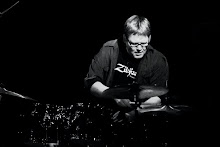
I heard this on the radio the other day so I tried to figure it out. A couple of things are a little tricky,
You have to get the RH over to the snare to play the open sound on the + of 1 in every 4th bar (there isn't time to move the LH to the open snare from the rim click, especially because I think I took this a little under the original tempo) and I thought the drummer kept the hi-hat going so I played it with my foot while my RH is moving over.
It's a sort of fun relentless groove. Sort of also reminds me of Merengue too. All musics are related!
Later!
Friday, August 17, 2012

Thursday, August 16, 2012
2 brush variations for Right Hand
Here's a couple of more brush variations, mainly what the right hand does makes them slightly different.


In the first one the R.H. slides away from you on 1 and 3, and taps 2,4, and the skip beat. I call it Back Beat because I like accenting 2 and 4 a bit.

In the second one we're tapping the skip beat and moving towards us on beats 1 and 3. Coming off the drum with an accent on 2 and 4. Sort of "flicking" the brush away, hence the title.
Hope you enjoy these. Thanks!
Tuesday, August 14, 2012
4 limb single stroke melodies
Hey all,
I'm going to demonstrate something I stole from Mike Essoudry at Carleton Jazz Camp this week. Mike explained the idea of playing any rhythm and alternating between all 4 limbs in a predetermined order. He was talking about using it for reading studies but I thought I would apply it to standard melodies.
There's a few things about this that are cool:
1. It helps strengthen your knowledge of whatever melody you're playing.
If you don't know the tune really well, the whole thing will fall apart very quickly.
2. It gets you used to playing the rhythm of a melody, without necessarily playing its pitch contour.
You're almost assigning the rhythm of the melody to different pitches. (Which, by the way, is a concept Hal Galper talks about as a way of having hip rhythms in a solo.)
3. It gets you used to memorizing (by both sound and feel) repeating pitch patterns.
This will help you be ready to repeat ideas, even while improvising.
Here's the first example. One chorus of the melody to "Straight, No Chaser". The limb pattern is LF, RH, LH, RF. You could also sing the sound of the pitch pattern as ti,ss,pa, doom or something like that to help you memorize the sound.
Here's another example. This is "Billie's Bounce" with a RH, LH, RF, LF limb pattern. The cool thing about this melody is each chorus it starts on the next limb of the cycle, so I played it 4 times to start from each place.
Obviously there many other orders of limbs you can try. You can also split up melodies between 3 limbs and use the remaining limb in a more static, timekeeping way.
That's what music is, you continually walk towards the horizon, and it just keeps moving back on you! Good luck.
Monday, August 13, 2012
Peter Donald!
Hey all,
Been busy teaching at a camp (and am about to head to another). I hope to post some new brush patterns soon but in the meantime. let's all dig Peter Donald playing with John Abercrombie's great quartet with Richie Beirach and George Mraz.
What is Jazz? This is a pretty good definition, I think!
Been busy teaching at a camp (and am about to head to another). I hope to post some new brush patterns soon but in the meantime. let's all dig Peter Donald playing with John Abercrombie's great quartet with Richie Beirach and George Mraz.
What is Jazz? This is a pretty good definition, I think!
Friday, July 27, 2012
P.S. to rant and other stuff
Hello music friends!
One more item to include with my Olympic rant the other day. A lot of media as been including the Clash's classic tune London Calling in their coverage of the Olympics. (I tend to hear that in the openings before I switch it off. I'm boycotting any personal support of the games because of how London is treating musicians.) I find this hilarious. Has nobody involved listened to the lyrics? The subject matter of the song is the sort of thing the IOC is terrified of! No matter. Let's dig the clash!
They sound (and look) great!
Also, there's been a bit of a Steely Dan discussion lately through social media. Now I really dig the later stuff they did (Aja, Gaucho, as well as the recordings they've done after they've gotten back together) but in some ways I feel that original drummer Jim Hodder was just as great as the many drummers who played on later recordings. He's on Can't Buy a Thrill and Countdown to Ecstasy. He sounds beautiful throughout and even sings on the tune Midnight Cruiser.
The whole later Dan thing is a bit of a double edged sword, I feel. Yes, they were able to get the exact musician on each song that would play what they felt was the perfect thing, and they created a lot of incredible music. On the other hand they were a big part of the "studioization" of popular music in the 70s and 80s where band members would be replaced on tracks. (Now I know this is a process a lot older than Steely Dan, but they helped make it more commonplace, to be sure.)
There a sound a band has and I feel when you fill music with guest stars and studio legends, it doesn't feel the same. For another example, check out bands where all the vocals are one person multi-tracked as opposed to a blending of different voices. In Dan's case. Jim Hodder was the one who played all the crappy gigs and did all the tiring travel. (When they were still playing live.) There's a really funny story of them being laughed at by Sha Na Na when they were sharing a bill with them.
So here's a couple of tunes with the late, great, Jim Hodder.
Anybody know why Fagan didn't sing lead on that like the record? Another Dan mystery!
Thanks all!
Thursday, July 26, 2012
Bill Frisell
Hey,
Sorry about yesterday but now we have something beautiful as guitar great Bill Frisell reveals elements of his creative process interspersed with footage of his trio with Kermit Driscoll and Joey Baron. I was lucky enough to see this band several times when I was living in New York in the early 90s and they never failed to inspire. Enjoy!
".....Or Joey, I don't know. He's out of his mind so we never know what he's going to play!"
Wednesday, July 25, 2012
An Olympic level rant (or I hope nobody in Britain sues me for this title)
Hi all,
No doubt you're aware of the upcoming events in London in a few days. If you're a musician or music fan you also might be aware of the 2012 London Olympics attempt to exploit musicians by paying them nothing or next to nothing for their time, artistry, and expertise. If not, the London Telegraph does a good job of explaining the situation.
I've been fairly vocal about this on social media, and one surprising response I've gotten (including from some members of the media) is that musicians should not play for lousy compensation. Absolutely, I couldn't agree more. The trouble with this response (for me anyway) is that it doesn't address the underlying issues.
The Olympics and the IOC are a big corporate machine with deep pockets. They, like many similar such organizations, have decided that not paying musicians is a good way to cut costs (even though for them even paying the musicians very well would be just a drop in the bucket.) They are therefore saying music is not worth paying for and not valuable. Unfortunately, desperate musicians will play "for the exposure' or the Olympics will simply used canned music.
Hopefully this is an aberration and not a trend. Friends that played in the Vancouver Olympics tell me they were well paid. For now though, I refuse to watch, read about, engage in social media about, etc. ANYTHING to do with this year's Olympics. I have nothing against the athletes, I admire the work they have done to get where they are. However, artists such as David Occhipinti, for example, have worked just as hard and deserve our pride and support as much as any Olympians.
Okay, rant over. Thanks.
Subscribe to:
Posts (Atom)